


What if the garment you're wearing wasn't just a piece of fabric, but a 400-year-old whisper of Awadhi history captured in every delicate thread? It's often frustrating to browse ethnic wear boutiques in Canada only to find stiff, machine-stamped patterns that lack the ethereal soul of true Lucknowi craftsmanship. You likely appreciate that true luxury lies in the slow, deliberate process of creation, yet the global market is frequently saturated with synthetic imitations that fail to honor the legacy of authentic chikankari.
You deserve to understand the immense value behind the thousands of individual stitches that compose a single masterpiece, especially when deciding between the soft drape of Modal or the crisp breathability of Cotton. We promise to reveal the soulful artistry and intricate techniques that define this timeless craft, ensuring you can confidently identify genuine hand-work. This guide explores the historical journey of the craft and the meticulous labor of the karigars, helping you feel a profound connection to the heritage you wear.
Key Takeaways
- Journey through a 400-year legacy to discover how Empress Noor Jahan transformed this ethereal craft into a royal symbol of Awadhi culture.
- Uncover the meticulous six-step artisanal process that defines slow fashion, honoring the collaborative spirit between the Karigar and the Dhobi.
- Master the art of identifying authentic, hand-embroidered chikankari by recognizing the delicate imperfections that distinguish soulful human touch from machine-made replicas.
- Learn to transition these timeless garments into your modern Canadian lifestyle, from festive occasions to sophisticated everyday wear and versatile co-ord sets.
The Essence of Chikankari: More Than Just Embroidery
To understand the soul of Lucknow, one must first touch the fabric of its history. Chikankari isn't merely a decorative technique; it's a whisper of the past captured in white-on-white hand-embroidery. Born in the heart of Uttar Pradesh, this art form transforms simple cotton, muslin, or chiffon into a canvas of intricate motifs. It's a practice that demands immense patience, where every stitch is a testament to the slow fashion movement that prioritizes the human touch over mechanical speed. When you wear a piece from our Ayat Soft Elegance collection, you aren't just wearing a garment. You're draped in the sensory delight of feather-light fabric and the gentle, tactile relief of hand-spun threads that have defined elegance for centuries.
The experience of this craft is deeply sensory. You feel the coolness of the breathable fabric against your skin, a necessity born from the warm climates of the Indian subcontinent. The texture of the thread is distinct, raised just enough to be felt by the fingertips but delicate enough to appear like a shadow on the cloth. This "shadow work" creates an ethereal quality that mass-produced clothing can't replicate. It represents a cultural identity that transcends fashion trends, standing as a symbol of poise and understated luxury for the discerning wearer.
The Etymology and Meaning of Chikan
The word Chikan finds its origins in the Persian term Chakin, which translates to "wrought with needles" or "embroidery." Historically, this traditional embroidery style began as a subtle embellishment on fine muslins, often commissioned by the nobility of the Mughal courts. Over the 18th and 19th centuries, it evolved from simple white-work into an intricate luxury that defined the elite of Lucknow. It's vital to distinguish between Chikan, the physical work itself, and Chikankari, the broader craft and the lifeblood of the artisans who dedicate their lives to mastering these patterns. What started as a royal pastime has grown into a global hallmark of artisanal excellence.
The Symbolic Value of the Craft
Often described as the poetry of the needle, Chikankari serves as a living archive of Awadhi culture. Each floral vine and geometric lattice tells a story of a city that values grace and etiquette above all else. At Lucknow Threads, we don't just curate apparel; we honor an artisanal legacy that has survived the pressures of industrialization. By working directly with skilled karigars, we ensure that the soul of the City of Nawabs remains vibrant in every stitch. This commitment ensures that the modern woman can carry her heritage with pride and timeless sophistication, knowing her wardrobe supports a craft that is as resilient as it is beautiful.
A Legacy in Every Stitch: The 400-Year History of Chikankari
The story of chikankari begins in the 17th century, where it flourished under the opulent patronage of the Mughal Empire. It wasn't merely a decorative technique; it was a reflection of royal grace and an extension of the sophisticated lifestyle led by the emperors. While some historians trace its roots to East Bengal or even earlier Persian influences, the craft truly found its soul within the marble corridors of the imperial courts. This period established the foundation for what would become one of India's most cherished artisanal traditions, blending cultural motifs with a level of precision that remains unmatched today.
The Influence of Empress Noor Jahan
Empress Noor Jahan, the wife of Emperor Jahangir, is often celebrated as the visionary who refined this craft into a royal obsession. Legend tells us that her love for Persian aesthetics and the intricate floral carvings found in Mughal architecture inspired her to translate those patterns onto fabric. She encouraged her artisans to move away from heavy, colored silks and toward the ethereal beauty of "whitework," where white cotton thread was meticulously embroidered onto fine white muslin. This specific story of Lucknowi Chikankari highlights how a queen's personal passion birthed a global legacy. Her patronage didn't just create a fashion trend; it established Lucknow as the permanent epicenter of the craft, ensuring that the city's identity would forever be entwined with the needle and thread.
From Royal Courts to Modern Wardrobes
As the Mughal influence waned, the Nawabs of Lucknow embraced the craft during the 18th and 19th centuries. They transformed the city into a sanctuary for artisans, allowing the embroidery to evolve into the 32 distinct stitches we recognize today. The craft survived the colonial era's industrial shifts by adapting to the changing tastes of the elite, eventually transitioning from royal court wear to the wardrobes of modern fashion enthusiasts across the globe.
In December 2008, the craft received its Geographical Indication (GI) status. This legal protection ensures that only authentic embroidery produced in the Lucknow region can officially bear the name, preserving the livelihoods of thousands of local *karigars*. Today, the art form continues to thrive as it bridges the gap between ancient heritage and contemporary style. You can explore the heritage of Lucknow Chikankari work in our detailed guide to see how these storied patterns are reimagined for the modern woman. Discover the soul of this history in our latest collections, where every piece honors the hands that made it.
The Anatomy of Artistry: Understanding the Stitches and Process
The journey of a chikankari garment begins long before the first needle pierces the fabric. It starts with the "Kutub," the master designer who envisions the layout, followed by the "Chhapayi" stage. During this phase, artisans use hand-carved wooden blocks dipped in fugitive dyes, often indigo or lime, to stamp intricate blueprints onto the textile. These blocks are more than tools; they're heritage artifacts that ensure the symmetry and grace of the final piece. This blueprint guides the "Karigar" through every minute stitch, ensuring the soul of the design is preserved.
Creating an authentic Kurta isn't a solitary task; it's a symphony of hands. A heavily embroidered piece often takes 60 to 180 days to finish, depending on the density of the work. This slow, deliberate pace is why the craft remains a luxury of patience. Once the embroidery is complete, the "Dhobi" performs the final ritual, washing the fabric in specialized vats to remove the block-print ink. This reveal is magical, as the pristine embroidery emerges from the blue outlines to showcase its true, ethereal form.
The 32 Stitches of Lucknow
The vocabulary of this craft is written in 32 distinct stitches, categorized into three main textures. Flat stitches like Tepchi provide a delicate, linear grace, while embossed stitches like Murri and Phanda add a tactile, 3D dimension. The third category is the Jali, which provides a breathable, airy aesthetic. The complexity of these stitches directly dictates the garment's rarity. A piece featuring Zanjeera or Hool requires a higher level of mastery, often increasing the labor hours by 45% compared to basic floral motifs. You can explore these varied textures in our collections, where each piece tells its own story of skill.
The Human Element: The Life of a Karigar
The heart of Lucknow Threads lies in the quiet rooms of Lucknow's old quarters, where embroidery skills pass from mother to daughter and father to son. This is the essence of slow fashion. Artisans spend 8 to 10 hours a day in deep concentration, often working in natural light to preserve their eyesight. Jali is a thread-tension technique that creates lace-like windows without cutting the fabric. This dedication ensures that every garment isn't just clothing, but a piece of living history. In the 2023 artisan census, it's estimated that over 250,000 people in the Awadh region still contribute to this ecosystem, keeping the flame of tradition alive through their tireless focus.
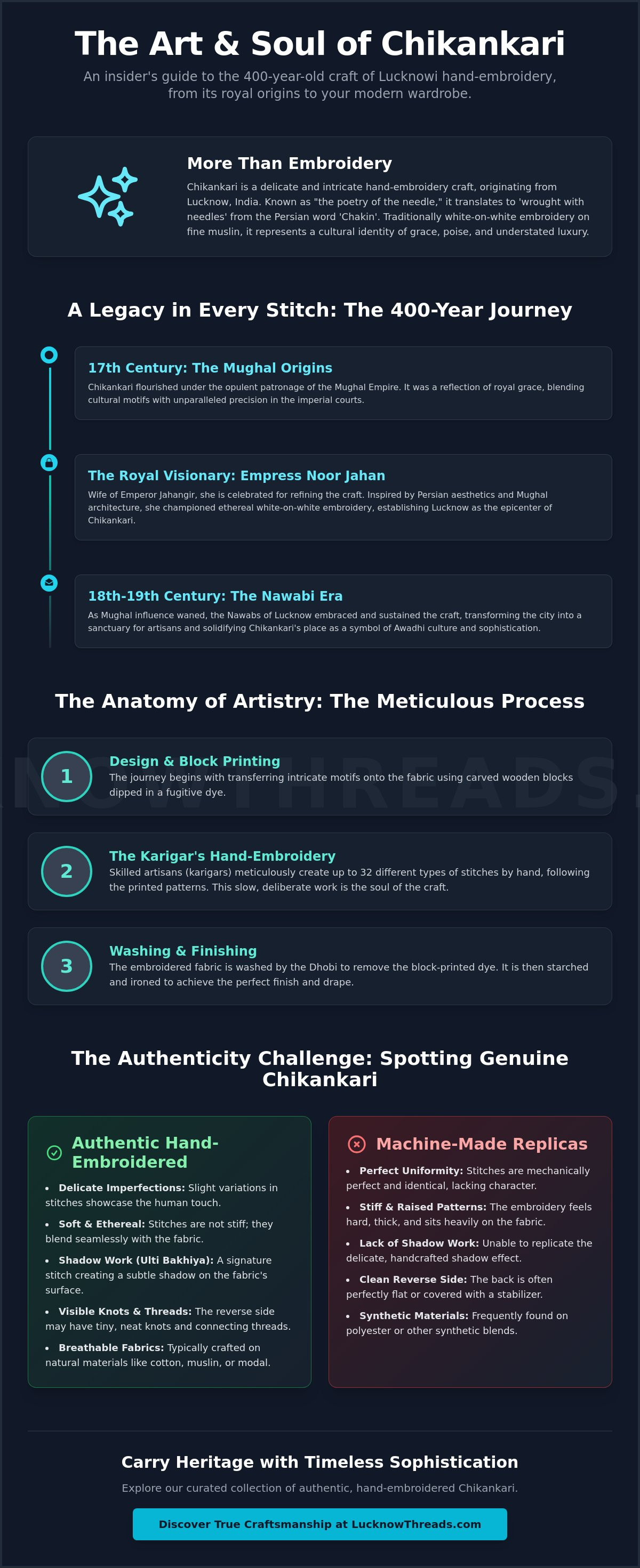
The Authenticity Challenge: Identifying Genuine Hand-Embroidered Chikankari
The global market is currently flooded with mass-produced imitations that threaten the very existence of traditional craftsmanship. Recent industry estimates suggest that nearly 65% of garments sold as "Chikan" in large retail chains are actually machine-embroidered replicas. While these pieces might mimic the patterns of chikankari, they lack the soul and the "ruhaniyat" that a dedicated karigar breathes into the fabric. A machine follows a cold, mathematical code; an artisan follows the rhythm of their heart. This distinction is what separates a disposable garment from a wearable piece of history.
For the discerning collector in Canada, identifying the real thing requires a quiet moment of observation. It's about looking past the surface to find the human story written in thread. Genuine hand-work is a slow art. It takes weeks, sometimes months, to complete a single tunic. When you choose authentic work, you're not just buying a dress; you're supporting a lineage of artisans who have kept this Awadhi legacy alive through centuries of change.
Hand-Stitched vs. Machine-Made: The Visual Test
The most reliable way to verify authenticity is to turn the garment inside out. This is where the secrets of the craft are hidden. In a hand-embroidered piece, you'll find a constellation of tiny knots and slight irregularities where the artisan has finished one thread and started another. These aren't flaws. They're the fingerprints of the creator. Machine embroidery, by contrast, shows a perfectly uniform, mesh-like finish on the reverse side because it uses a continuous bobbin thread.
Texture also tells a story. Hand-embroidery creates a distinct, "raised" effect on the fabric. Stitches like the Phanda (millet grain) or Keel Kangan (petal stitch) have a three-dimensional quality that catches the light. Machine work feels flat and clinical. It lacks the tactile depth that defines true chikankari. If the embroidery looks suspiciously perfect and feels smooth to the touch, it's likely a product of a factory, not a home in Lucknow.
Choosing the Right Canvas
The choice of fabric is just as vital as the stitch itself. The embroidery needs a canvas that can support the weight of the thread while remaining graceful. For those seeking summer elegance during a humid Ontario afternoon, the breathability of thin cotton Indian dresses is unparalleled. It's a fabric that understands the heat, offering a crisp yet soft silhouette that feels like a second skin.
In our curated collections, we often lean toward the luxurious drape of Modal and the versatile softness of Rayon. These fabrics allow the intricate needlework to shine without pulling or distorting. Because the market is so saturated, it's essential to learn how to choose an authentic shop that prioritizes transparency over mass-market speed. Shopping with confidence means knowing that your garment was made with patience and respect for the craft.
Ready to experience the difference of genuine, hand-crafted art? Browse our exquisite collections of authentic Lucknowi heritage.
The Modern Chikankari Wardrobe: Blending Grace with Contemporary Style
The evolution of chikankari from the royal courts of Awadh to the bustling streets of modern Canada represents a beautiful dialogue between heritage and the present. It's no longer reserved for grand celebrations or formal festivities. Instead, this artisanal craft has found a permanent home in the daily lives of women who value slow fashion and meticulous detail. Whether you're grabbing a coffee in Yorkville or attending a professional meeting in downtown Calgary, these hand-embroidered pieces offer a level of sophistication that mass-produced garments simply can't replicate. The transition to everyday wear reflects a growing appreciation for the "slow fashion" movement, which saw a 22% increase in consumer interest across North America in 2023.
Styling the Contemporary Co-ord Set
The Ayat Soft Elegance collection epitomizes this shift toward effortless versatility. Co-ord sets have become a staple for the modern woman, offering a cohesive look that feels both polished and relaxed. You can easily break these sets apart to create multiple outfits that suit a Canadian climate. Try pairing a hand-worked top with high-waisted denim or tailored trousers for a sharp, Indo-Western fusion. To add a layer of ethereal grace, drape the Chandni Chiffon Dupatta over your shoulders. This simple addition transforms a casual ensemble into something truly poetic, proving that tradition has a place in every hour of the day.
Chikankari for Every Occasion
The modern wardrobe demands adaptability. The short kurti has emerged as a favorite for professional environments, providing a breathable yet structured option that pairs beautifully with leggings or pencil skirts. For those moments that require a bolder presence, the Layla Blue set offers a striking balance of heritage and high-fashion impact. It’s a choice that speaks of confidence and cultural pride, standing out in a sea of fast-fashion trends.
- The Professional Edit: Use short kurtis as a sophisticated alternative to the standard button-down shirt for a unique office look.
- Evening Allure: Opt for deeper hues like the Layla Blue to stand out during gala events, charity auctions, or formal dinners.
- Timeless Luxury: White-on-white chikankari remains the gold standard of understated elegance, reflecting a consistent preference for monochromatic artisanal wear in luxury boutiques.
Chikankari bridges the gap between worlds. It honors the slow, deliberate work of the karigars while meeting the fast-paced demands of a global lifestyle. Each stitch tells a story of a craft that refused to be left in the past, finding new life in the closets of women who carry their culture with quiet confidence. By integrating these pieces into your regular rotation, you're not just wearing a garment; you're preserving a legacy of hand-crafted excellence.
Carry the Spirit of Lucknow Into Your Modern World
Owning a piece of this 400 year old tradition means more than simply adding a garment to your closet; it's about preserving a legacy that first flourished in the royal courts of the Awadhi era. You've discovered how to distinguish authentic hand embroidery from mass produced imitations and explored how these intricate patterns transition seamlessly into a contemporary Canadian wardrobe. Every stitch tells a story of profound patience, where skilled karigars spend weeks meticulously crafting a single piece of chikankari to ensure its ethereal beauty remains timeless. Lucknow Threads was founded by a Lucknow native to bridge the gap between these traditional artisans and the global stage, bringing the soul of the City of Nawabs directly to your doorstep. Based in Toronto, we provide global shipping to ensure this exquisite heritage is accessible to those who value the slow fashion movement. You don't have to compromise on quality or soul when seeking artisanal elegance. Experience the timeless grace of Lucknowi heritage and explore our curated collections of authentic chikankari today. Your journey into the heart of Indian craftsmanship is just beginning, and we're honored to walk this path with you.
Frequently Asked Questions
What is the difference between Chikan and Chikankari?
Chikan refers to the delicate embroidery itself, while Chikankari is the complete, centuries-old art form that encompasses the entire process of creation. This storied heritage from Lucknow involves 36 distinct stitching techniques, each meticulously crafted to transform a simple fabric into a masterpiece of Awadhi culture. When you wear these garments, you're not just wearing a design; you're carrying a legacy of artisanal grace that has survived for generations.
Is all Chikankari done by hand?
Authentic Chikankari is exclusively handcrafted by skilled karigars who often spend 10 to 15 days on a single small motif to ensure its ethereal quality. While the modern market in Canada sees a rise in machine-made imitations, these lack the soulful texture and three-dimensional depth of true hand-embroidery. Our brand remains committed to the slow fashion philosophy, ensuring every stitch is a testament to the patient, manual labor of our artisans.
Why is authentic Chikankari so expensive?
The cost reflects the hundreds of hours a dedicated artisan invests in hand-stitching intricate patterns that a machine simply cannot replicate. A single heavy saree can take 6 to 12 months to complete, making it a rare heirloom rather than a mass-produced item. In the Canadian market, these pieces are valued as wearable art, especially since the number of master craftsmen practicing all 36 traditional stitches has decreased by 30% over the last few decades.
Can I wash my Chikankari clothes at home?
You can safely hand wash lighter cotton or georgette pieces at home using cold water and a gentle, silk-safe detergent. It's best to avoid harsh scrubbing to protect the intricate threadwork, and you should always lay the garment flat to dry in a shaded area. For heavier silk ensembles or those with metallic embellishments, professional dry cleaning is the only way to preserve the garment's structural integrity and timeless elegance.
What are the most common fabrics used for Chikankari?
Historically, this art flourished on fine muslin and mulmul, but modern artisans now utilize a variety of breathable and luxurious textiles like georgette, chiffon, and chanderi silk. These fabrics provide an ethereal canvas for the delicate white-on-white or pastel threads, allowing the embroidery to stand out with a graceful, flowing silhouette. Each fabric is chosen for its ability to hold the weight of dense hand-embroidery while maintaining a sophisticated, high-fashion aura.
How can I tell if my Chikankari is machine-made?
You can identify authentic hand-embroidery by examining the reverse side of the fabric, where you'll find small knots and slight human irregularities that signify genuine craftsmanship. Machine-made versions appear too perfect and flat, often featuring loose threads that span long distances between motifs on the back. True chikankari offers a rich, embossed texture that feels substantial to the touch, reflecting a level of detail that industrial needles can't achieve.
Is Chikankari only for traditional Indian occasions?
Chikankari has evolved into a versatile global style that's perfect for everything from a summer garden party in Vancouver to a formal corporate event. Modern silhouettes like embroidered tunics and capes pair beautifully with contemporary trousers, blending the heritage of Lucknow with a modern woman's wardrobe. It's a style that celebrates feminine poise and confidence, making it a sophisticated choice for any occasion that calls for a touch of ethereal charm.
What is the significance of the "Jali" work in Chikan embroidery?
Jali work is an exquisite technique where the karigar creates a delicate, net-like lace effect by carefully pulling the warp and weft threads apart without ever cutting the fabric. This specific stitch represents the pinnacle of artisanal skill, requiring immense precision to ensure the fabric's strength remains intact while appearing translucent. It mirrors the intricate stone lattices found in Mughal architecture, adding a sense of historical depth and architectural grace to the garment.